About 85% of a Pahang forest reserve has just been removed
The Satak forest reserve has not been logged since 2001. Why was most of it removed recently?
It takes less than an hour to drive between Kuala Lipis and Raub. These cities in the western interiors of Pahang were once booming hubs of gold mining. Now, there appear few attractions beyond nostalgia. And durian, perhaps.
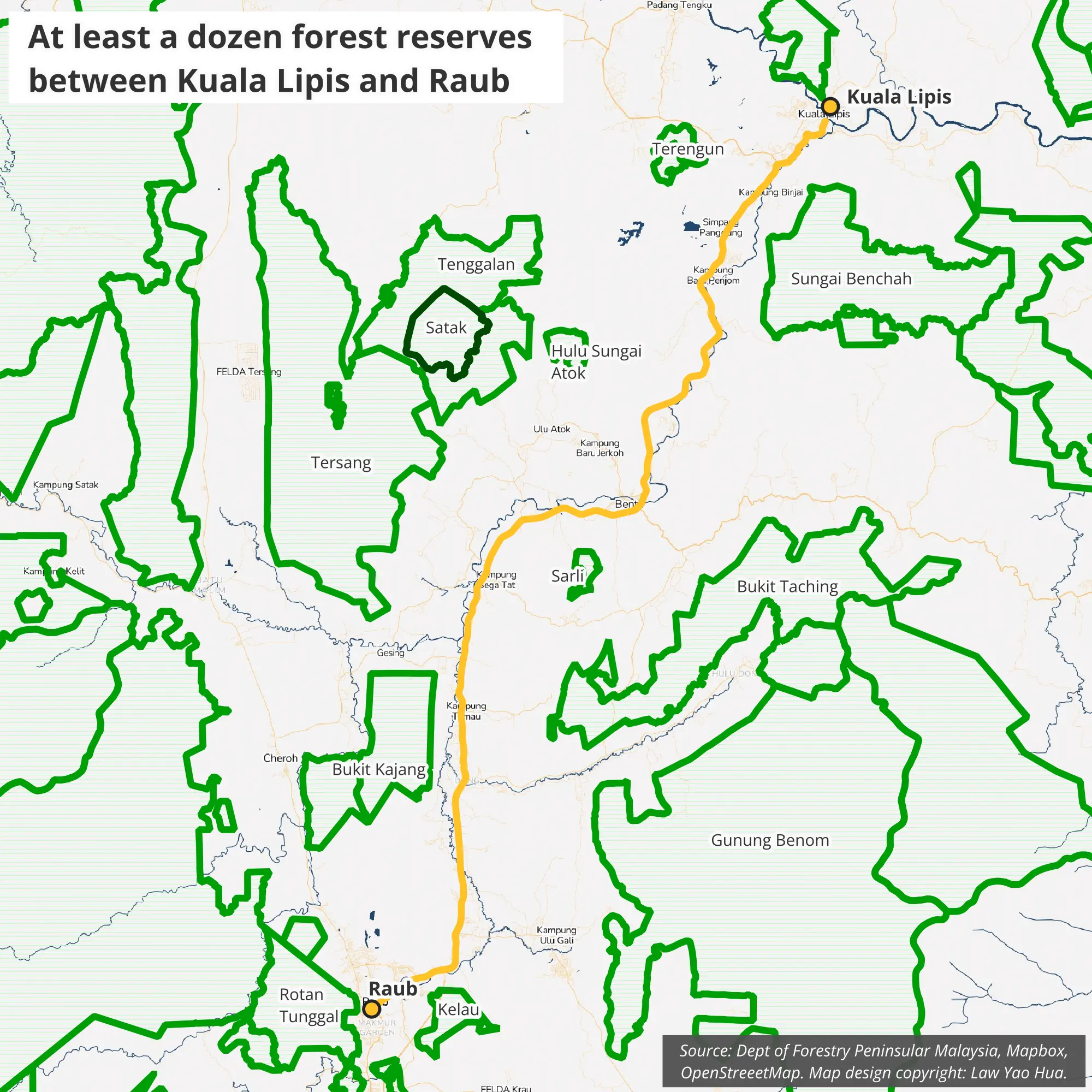
But, instead of gold, today Pahang can brag about a treasure that is far more communal and beneficent. The state has the most forest reserves in Peninsular Malaysia. Between Kuala Lipis and Raub, travelers would zip pass at least a dozen forest reserves.
Terengun, Sungai Benchah, Tersang, Sarli, Gunung Benom, … These forests are descendants of some of the oldest rainforests on Earth. They have been protecting our air, rivers, soil, wildlife, and therefore our ways of life.
Copyright: Law Yao Hua
Special Satak, threatened
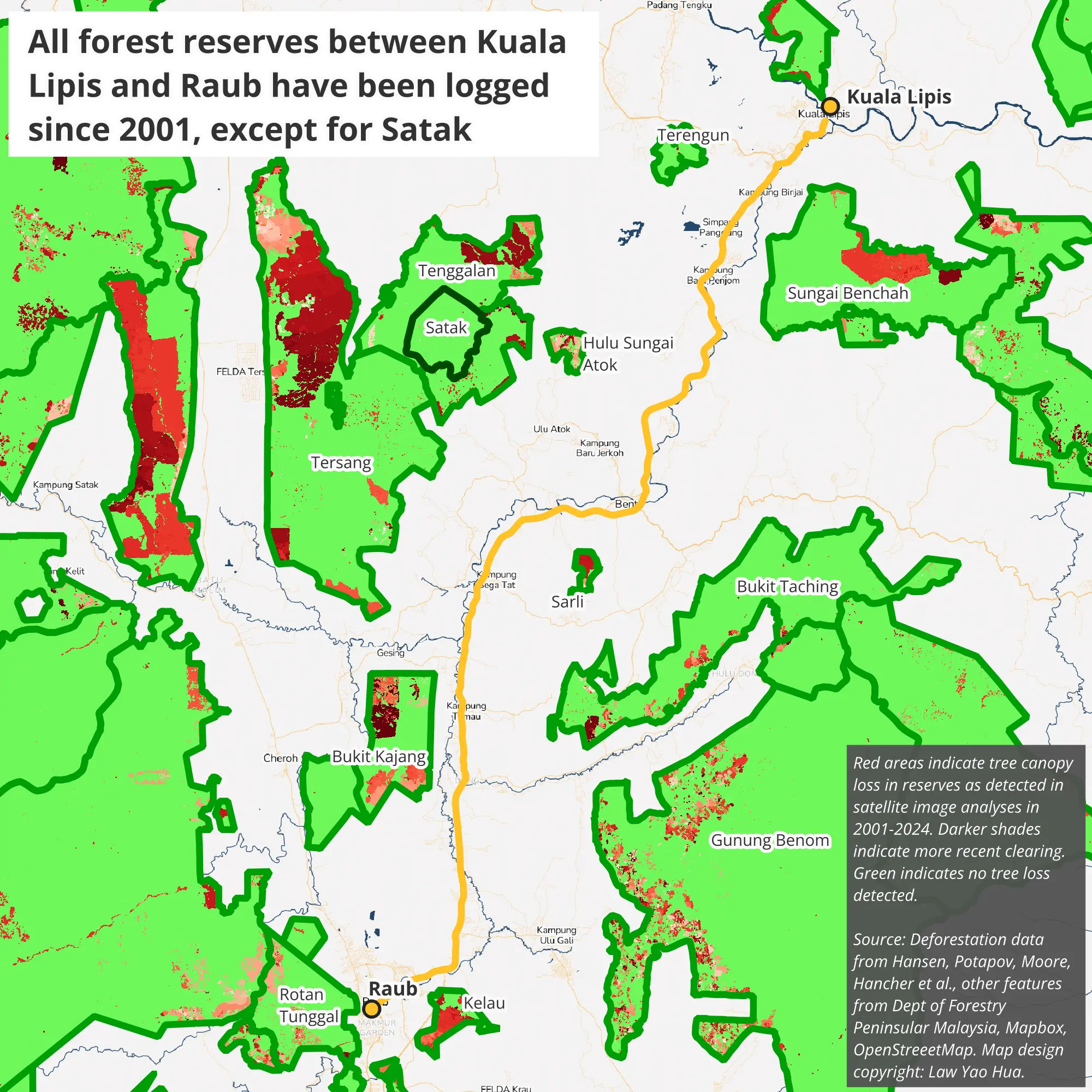
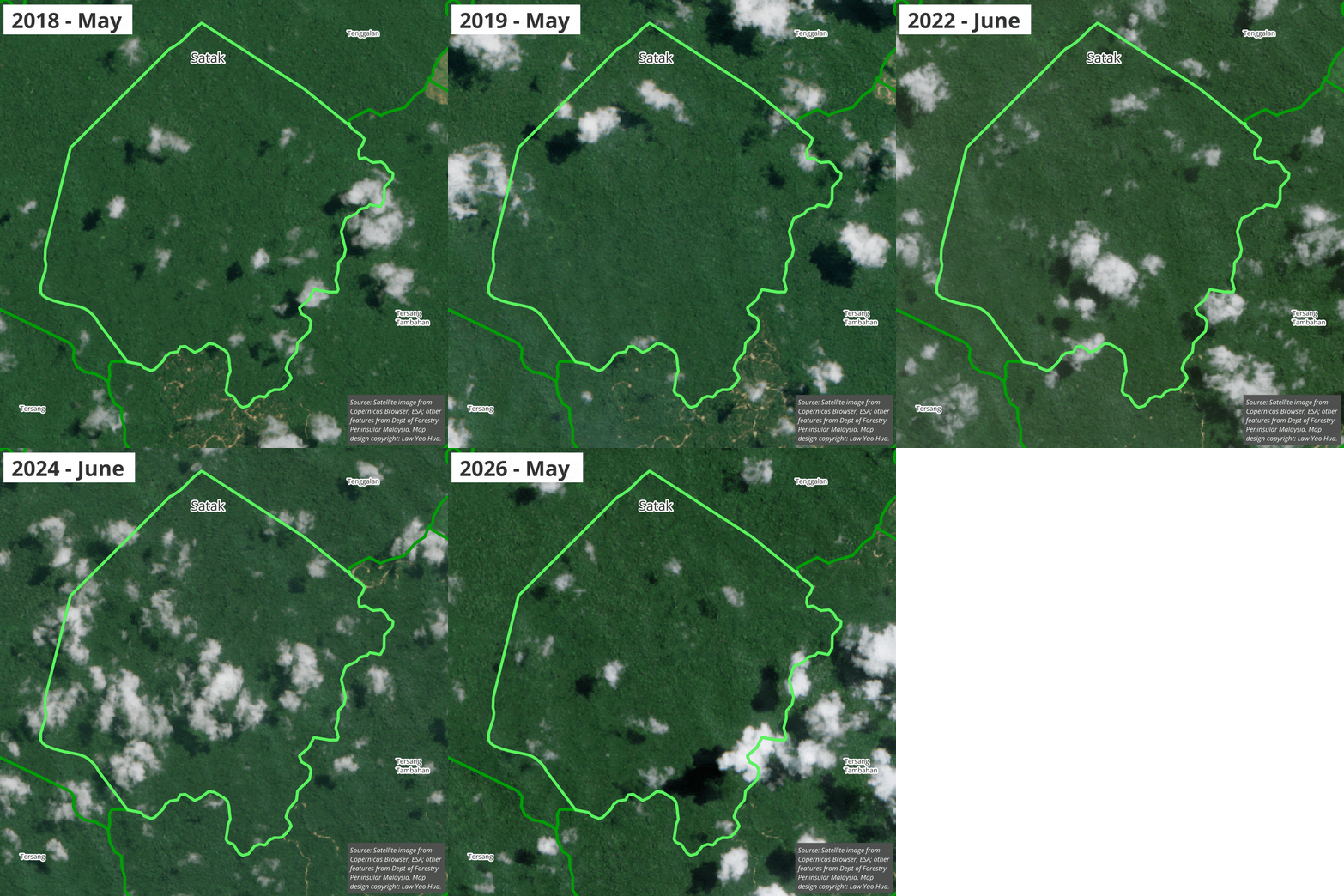
And even in this basket of treasures, one gem stands out: the Satak Forest Reserve. It is the only reserve out of the dozen that has not been logged or reduced since 2001. As best as satellite imagery analyses could tell, Satak’s canopy has remained an untorn green blanket in the last 24 years.
Copyright: Law Yao Hua
What’s more astounding is that Satak can be logged. The 1,072 ha reserve is classified as a “production forest”; the trees can be cut for timber. That classification is shared by roughly 70% of forest reserves in Peninsular Malaysia. In my 6 years of forest reporting, I have not seen a “production forest” spared either the chainsaw or degazettement since 2001.
(‘Degazettement’ means an order by the state government to legally strip a forest of its reserve status and thus, restrictions on extraction.)
Copyright: Law Yao Hua
So, yes, I think Satak is special because it offers a delightful exception in the general exploited fate of our forest reserves.
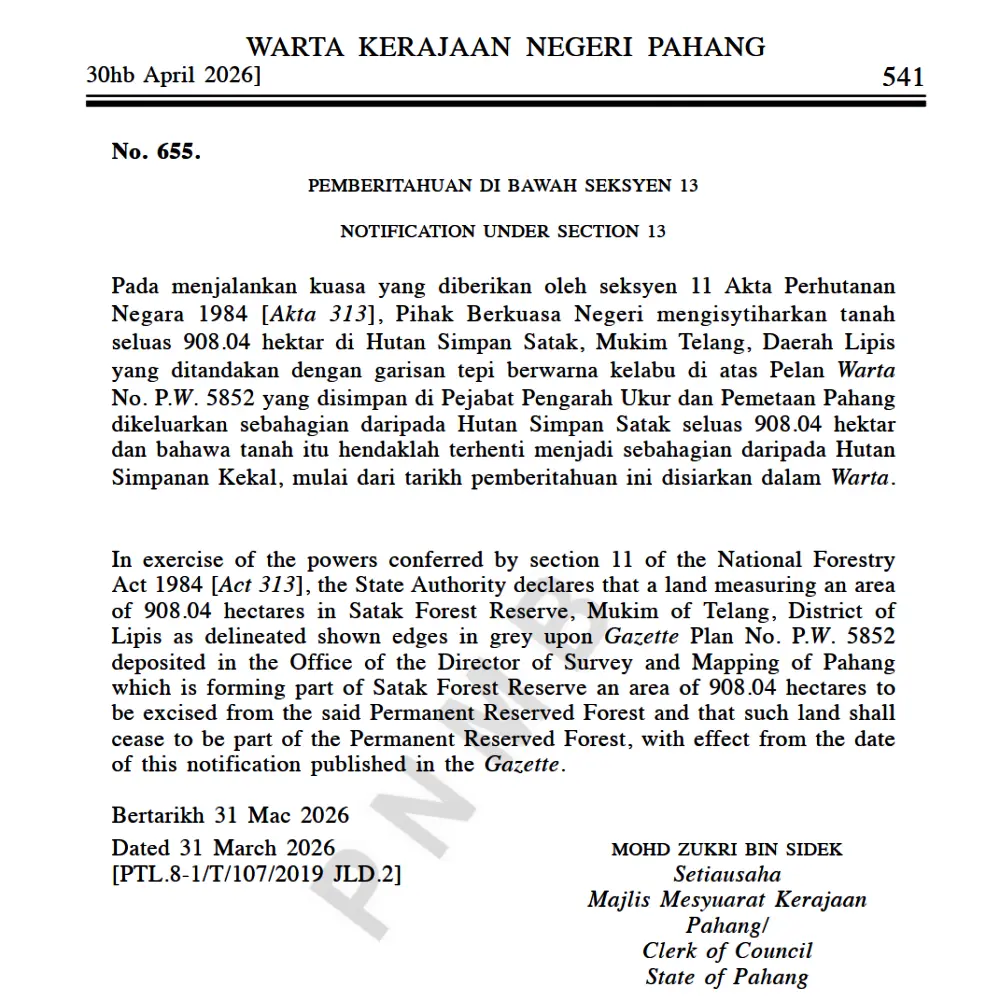
The exception lasted until 11 days ago. On 30 April 2026, the Pahang government announced (gazette number #655) that it has degazetted 908 ha of Satak. Only 164 ha, or 15%, of the original 1,072 ha remains a reserve.
Replacement in size, and quality?
Note that Pahang often “replaces” reserves it removes with new areas of equal sizes. Between 1 May 2025 and 10 May 2026, the state has made 17 additions and 10 removals for a net increase of 567 ha. Therefore, we cannot fault Pahang for reducing the area of forest reserves.
BUT how good were the replacements? Did the new areas harbour as much life and protect our ways of life as well as those degazetted? Did the replacements have wild boars, rattan, and fertile topsoil? I don’t think anybody outside of the government knows.
(The first step to the answer is to check every gazette plan (pelan warta) of the replacements. It’s one of my grand plans. If you are keen to try, tell me.)
Why degazette Satak?
I cannot figure out a rational reason to explain Pahang degazetting 85% of Satak. I considered 4 5 possibilities and struck out the 3 conventional ones. The last one appears most likely: rare earths mining durian plantation.
Tree farms? Degazettement unnecessary
Tree farms, or ‘forest plantations’ as the Malaysian government calls them, are plantations of fast-growing trees to be harvested for pulp or wood. Most, if not all, tree farms in Peninsular Malaysia are operating inside forest reserves. The developers clear the reserves and replant with neat rows of a single tree species. My experience reporting on tree farms suggests that many planters would love to have Satak. But they could do so without degazetting Satak. So, I don’t think a tree farm is in the works here.
Oil palm? It couldn’t sell
MSPO, Malaysia’s mandatory certification for its oil palm industry, prohibits clearing natural forests since January 2021. While the Malaysian Palm Oil Board cannot stop anybody from planting oil palm on deforested land, it can prohibit the trade of oil palm from that site. It would really be a stretch of (horrible) imagination to have a state government degazette forest reserve to plant oil palm in 2026. VERY unlikely.
Gold mine? Perhaps, but this is too large
State governments like gold mining projects. But almost all gold mines are smaller than 200 ha, according to the environmental impact assessment reports submitted to the government. It is possible to have much bigger gold mines, but I would expect the miner to proceed in smaller parcels, rather than a fell swoop of 900 ha.
Rare earth mining? Most likely
The regulations and valuations for rare earth mines would fit the scenario of degazetting a forest reserve like Satak. While I haven’t been actively monitoring rare earth mining projects in Malaysia, I know that these projects are prohibited inside forest reserves, and they can be more than 1,000 ha large. For example, the rare earth project in Perak by MCRE Resources Sdn Bhd is nearly 2,200 ha large. The project paid Perak millions in royalty within months, reported Macaranga. Now that 85% of Satak is no longer a reserve, I wouldn’t be surprised if the Department of Environment receives an environment impact assessment report for rare earths project within the year for Satak.
Durian plantation? Most likely (This section added on 12 May)
After posting this story, some friends suggested that the degazetted forest might be turned into a durian plantation. They have been monitoring land use and forest changes for decades, and their tips brushed aside my earlier doubts about a durian project here.
First, they reminded me that the Pahang government is pushing to build a huge durian export and tourism industry in the adjacent district, Raub. Already, the private sector – including listed companies – have invested and continue to invest hundreds of millions of ringgit into durian production (an example).
Second, they corrected my misconception that durian farms can’t be 900 ha huge. They pointed to durian plantations upwards of 1,000 ha. I was stuck in my childhood impression of smallholder durian orchards, when in fact, durian’s future is industrial now. (And also financial…given that at least one corporate is promoting durian plantations as investment schemes coupled with funerary services).
Having considered the above, I thought it makes sense that the state government would degazette a forest reserve if it wants to make way for a durian plantation. I had thought the National Forestry Act 1984 prohibits fruit plantations in forest reserves. The Act says:
Acts prohibited in permanent reserved forests: …. clear or break up any land for cultivation or any other purpose; …
Foresters have also told me numerous times that they do not allow commercial planting of durian trees in reserves. (Planting durian trees as tree farms in reserves used to be legal because foresters consider that as ‘timber production’, not ‘fruit’. But the Department of Forestry Peninsular Malaysia later saw it as a loophole used by planters to sell durians and issued a ban on this practice a few years ago.)
HOWEVER! Maybe I had misunderstood the law, and there remains a way for durian planters to operate legally inside forest reserves. I say this only because I was shown a big durian plantation running in the western half of the Tersang Forest Reserve, just 11 km directly west of Satak.
Said durian plantation spans more than 1,300 ha. About 1,300 ha of the forested site was cleared in 2016 and replanted with durian trees. (Later in 2021, another 600+ ha was cleared to the south but I don’t know what’s planted there now.) The entire site remains part of the Tersang Forest Reserve, according to my review of gazettes, forest maps from the Department of Forestry Peninsular Malaysia, Raub’s Local Plan 2035 (published 2021), and the public summary of Pahang’s Forest Management Certification Audit (2025).
(Technical bit for those who know: The Malaysian Timber Certification Scheme’s Certificate for Forest Management is an audited certificate that says a state forestry department is meeting global standards of sustainable management of natural forests. But I have found again and again instances of non-natural forests included in the audited areas. The auditors replied saying they have done their review of maps and field checks and found no breach. I wonder how would they explain including this 1,300 ha durian plantation in the Tersang Forest Reserve in the map of their audit summary? And oh, the Netherlands was satisfied with the scheme too.)
Other clues in the Local Plan for Lipis (This section updated 12 May 2026)
(If you share my unhealthy drive to figure out what the authorities plan for Satak…)
One clue on the future of Satak might lie within the Local Plan (2035) for Lipis District, where Satak is located. The public consultation period for this Local Plan ended in October/November 2025. I haven’t found a digital copy (the provided link is broken). The 2020 edition shows no development plan for Satak. A reader passed me a working link to the draft Plan after I posted this story. The Plan 2035 shows Satak as intended for forest, just as in the Plan 2020. Plan 2035 also categorises Satak as Environmental Sensitive Area 2 that prohibits development, agriculture, and allows only logging that is selective and restricted.
If you have clues, I’m eager to hear them! Together we should continue to monitor Satak.
Don’t forget Satak!